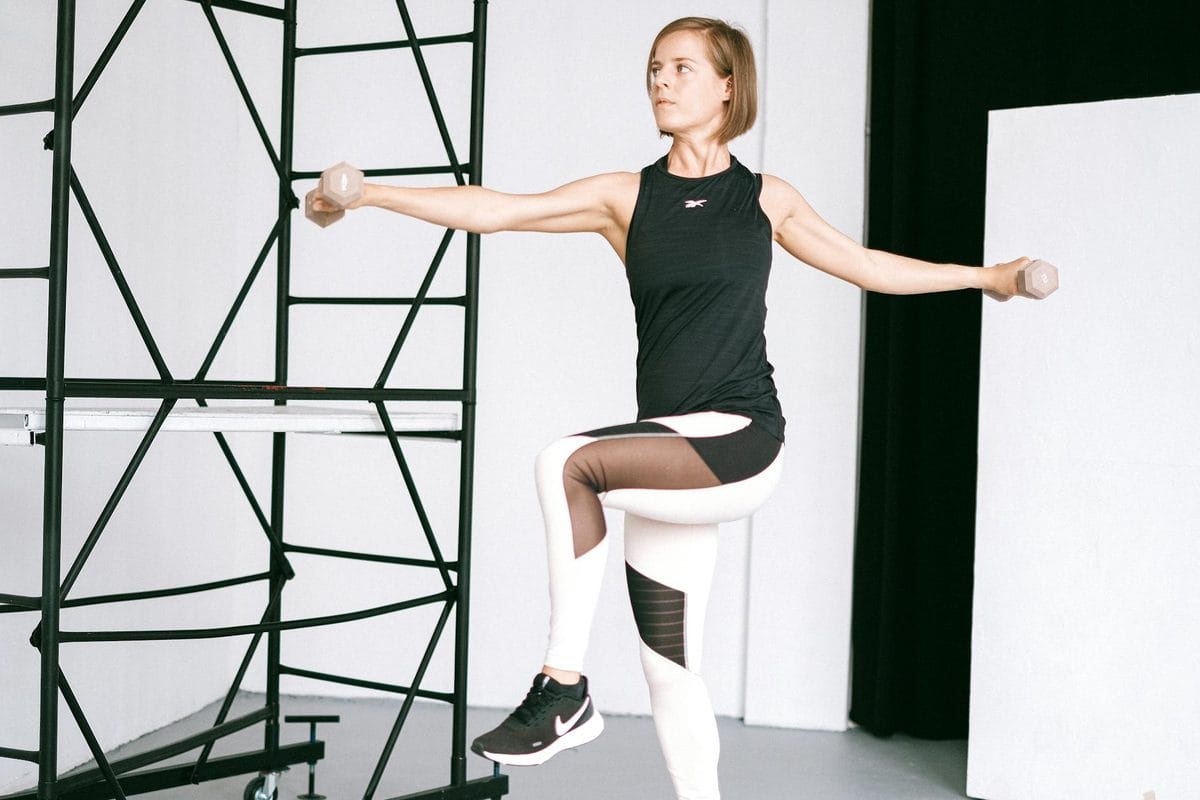
The bench in the corner of the spare room holds two adjustable dumbbells, a door anchor, and a tangle of resistance bands that cost less than a single month at most gyms. People look at that setup and assume it has a ceiling somewhere around "toned, never strong." They are wrong, and the reason they are wrong is the most misunderstood idea in all of strength training: progressive overload is not a synonym for adding plates to a barbell.
Overload means you ask the muscle to do slightly more than it did last time. That "more" can arrive as weight, yes. It can also arrive as another rep, a slower lowering phase, a shorter rest, a harder leverage, a longer band, a deeper range, or a single-leg version of something you used to do on two. A barbell gives you one of those levers. A home kit with dumbbells and bands gives you all the others, plus weight in smaller, more usable jumps. Once you see that, the whole "you can't get strong at home" argument falls apart in your hands.
What overload actually demands from your training
Strength adapts to a clear, repeated signal: tension that pushes close to the edge of what you can manage, applied often enough and recovered from well enough that your body decides it had better build something. The body does not read the label on the equipment — it reads effort, time under tension, and proximity to failure. A set of ten Bulgarian split squats holding 12 kg dumbbells, taken to where the eleventh rep genuinely would not happen with clean form, is a strength stimulus by any honest definition. The bar across town has no monopoly on that.
Here is the part most home trainees miss. The reason their dumbbell program stalls isn't the dumbbells — it's that they never actually got close to failure, never tracked anything, and changed the workout every week because variety felt productive. Variety is the enemy of overload. You cannot beat last week if you can't remember what last week was. Pick movements, keep them for a block of six to eight weeks, write down what you did, and beat it. That discipline matters more than any piece of kit.
The weight lever: why adjustable dumbbells earn their price
If you buy one thing, buy a pair of adjustable dumbbells with small increments. Fixed 5 kg hex dumbbells trap you: the next jump is to 7.5 kg, a fifty percent leap your shoulders will refuse on an overhead press. Bowflex SelectTech 552s adjust from roughly 2 kg to 24 kg per hand; PowerBlock Elite go finer with the small adder pins, letting you nudge a press up by 0.5–1 kg at a time. Those micro-jumps are the whole game for upper-body lifts, where women often have less absolute strength to spare and a clumsy jump stalls progress for a month.
A realistic strength range at home looks like this: a reasonably trained woman might goblet squat 16–22 kg for sets of 8, Romanian deadlift 20–24 kg per hand for sets of 10, dumbbell bench press 12–16 kg per hand for sets of 8, and overhead press 7–10 kg per hand. Those are not toy weights. Held for the right reps at the right effort, they build the same dense, capable muscle a barbell would — and adjustable dumbbells let you walk them up half a kilo at a time instead of begging the body to make a fifty-percent jump.
Rest matters as much as load. For a true strength stimulus, take two to three minutes between hard sets of a big lift. Most people at home rush this because they want to be done, and a rushed strength session quietly becomes a mediocre conditioning session. Set a timer, walk away, and let the muscle recover enough to actually express force next set — a set taken at eighty percent freshness taught your body very little.
Bands: the lever almost everyone uses wrong
Resistance bands have a reputation as the warm-up tool you keep meaning to throw out, and that comes from people treating a band like a fixed weight, which it is not. A band gives you ascending resistance — easy at the start of the range, brutal at the end — and that property is either a gift or a problem depending on whether you understand it.
The gift: bands punish you exactly where free weights go easy. At the top of a banded chest press, where a dumbbell would be coasting on momentum, the band is fighting hardest. That makes them superb for lockout strength, for glutes (a heavy band on hip thrusts hammers the very top contraction), and for fast, explosive work where you want resistance that climbs as you accelerate. The problem: you cannot read a band's resistance off a number, so progressing it takes more thought than progressing a dumbbell.
You progress a band four ways. Shorten it — stand further onto it, or wrap it once, and the same band becomes meaningfully harder. Stack it — add a second, lighter band alongside a heavy one. Move along the strength curve — anchor higher or lower to bias resistance toward the part of the rep you want to attack. And change the tempo, because that turns a too-easy band savage without changing anything else. Decent loop bands from brands like WODFitters or Rogue come in graded tensions, and the honest move is to own three or four so you always have a "next one up."
The set that ends at rep nine when you planned for ten, with the tenth genuinely not there, taught your body more than three comfortable sets of fifteen ever will.
When you can't add weight: the levers that actually rescue progress
This is the question that sends home trainees back to the gym. You've maxed out your dumbbells, the heaviest band is on, and you're supposed to be progressing. What now? Load was never your only currency, and the people who thrive at home are the ones who learned to spend the others.
Reps, then sets. The simplest progression remains the best. If you pressed 14 kg for three sets of 8 last week, aim for 3×9 this week, then 3×10, then 3×11–12. Once you clear the top of your rep range across all sets, the weight goes up and the reps reset to the bottom. This is double progression, the quiet engine behind nearly every successful home program. Add a fourth set before you add weight if the jump would be too big — more total hard reps is more overload, full stop.
Tempo. This is the lever that lets a fixed weight feel heavier every week without touching the dumbbell. Lower the weight over four to five seconds, pause for one to two seconds at the hardest point, then lift with control. A goblet squat with a five-second descent and a two-second pause in the hole is a different animal from the bouncy version — same 18 kg, vastly more time under tension and far closer to failure. Tempo work is unglamorous and it works, and it is the single most under-used tool in the home arsenal.
Range and leverage. Elevate your front foot on a step for split squats and the range deepens, the stretch loads harder, and your old weight is a challenge again. Progress a push-up by slowing it, then elevating the feet, then dropping to a deficit off two books — bodyweight has a long, steep ladder if you stop treating it as one fixed exercise. Single-limb work is the cheat code: the moment a movement gets too easy on two limbs, do it on one, and your effective load roughly doubles with no new equipment at all.
Density and rest. Do the same total work in less time. If last week's session was 24 hard sets in 50 minutes, do it in 45. Shaving rest while holding load and reps raises the demand on muscle and heart both — use it sparingly inside a strength block, but as a way to keep overloading a plateaued lift, it's legitimate.
A block that holds together for eight weeks
Theory is cheap. Here is a structure that uses these levers in order, so you're never out of road. Train three days a week, picking five to six movements per session: a squat pattern, a hinge, a horizontal push, a horizontal pull, a vertical push or pull, and one direct glute or core piece.
- Weeks 1–3: add reps. Start each lift at the bottom of its range (say 3×8) and climb to the top (3×12) across the three weeks. Write every number down — the notes app on your phone is fine, the writing-it-down is what's non-negotiable.
- Week 4: add weight where you can, reset reps to the bottom. Where the dumbbells won't go higher, add a set or add tempo instead. This is the week the adjustable increments pay for themselves.
- Weeks 5–6: introduce a four-to-five-second lowering phase on your two hardest lifts. The weight may even drop slightly; the difficulty will not. Keep climbing reps underneath the new tempo.
- Week 7: attack leverage — elevated split squats, single-arm rows, feet-up push-ups, banded work shortened by a wrap. Same kit, harder positions.
- Week 8: a lighter deload, then retest your key lifts. You will almost always find the old hard weight now moves for two or three more reps than it did in week one. That is the overload made visible.
Effort is the thread running through all of it. Keep most hard sets at an RPE of 7 to 8 — you finish with two, sometimes one, good reps left in the tank. Drift below that and the signal fades; live constantly at RPE 10 and you'll bury your recovery and stall anyway. The sweet spot is uncomfortable but repeatable, week after week, and it is where strength is actually built.
The honest limits, because they exist
None of this means a home kit equals a fully stocked barbell gym for every goal. If your aim is to deadlift 140 kg or back-squat double bodyweight, you will eventually need a loaded bar and the room to drop it — adjustable dumbbells topping out at 24 kg per hand cannot match that. Heavy hinge patterns are where home kits hit their hardest wall, because your legs and back will out-strip what two dumbbells can supply long before your upper body does.
But that ceiling sits far higher than almost anyone assumes, and for the goals most women actually hold — being genuinely strong, carrying real muscle, moving through life without things feeling heavy — a thoughtful home setup will take you years before it runs out of road. The barbell isn't magic. Tension, progression, and the patience to beat your own logbook are. The bench in the spare room has all three the day you decide to use them properly.