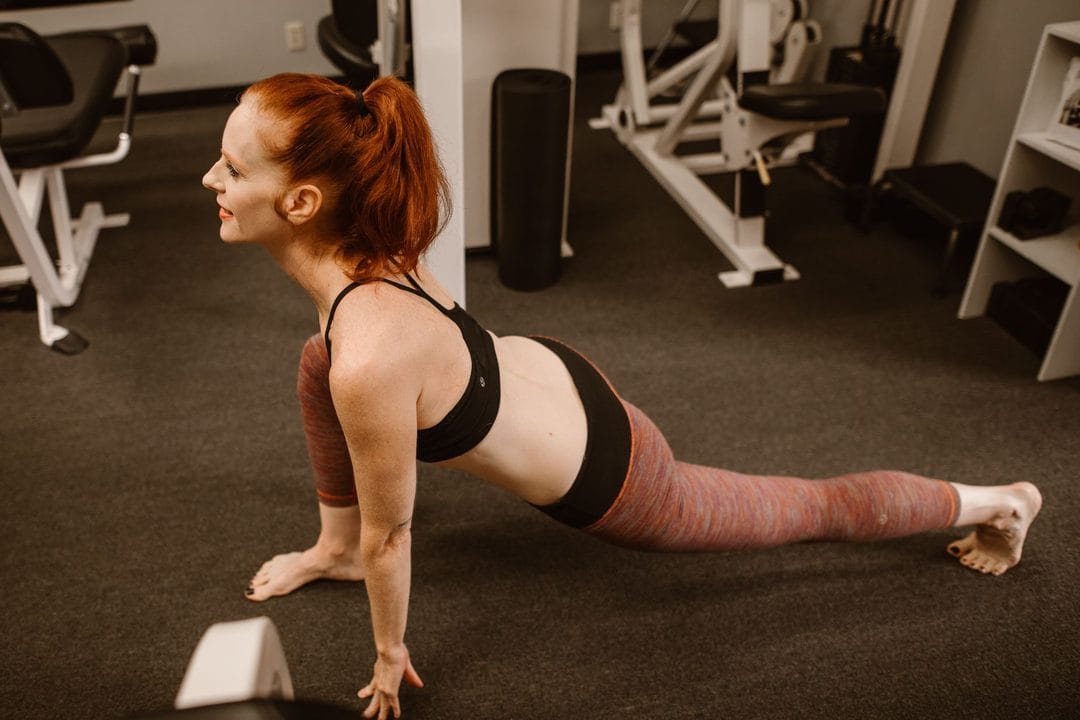
Watch the warm-up area of any busy gym around 6 p.m. and you'll see the same pattern: women heading straight for the squat rack after ninety seconds on a bike, while a handful of guys are on the floor doing what looks like yoga. That's not a coincidence, and it's not really about flexibility culture, either. It's about who got taught that the joint has to move before the muscle can load it safely — and for most women who lift, nobody ever taught that part.
The Mistake Hiding Inside a Stalled Squat
If your squat depth has plateaued, your low back rounds out of the hole, or your knees cave in no matter how many cues your coach gives you, the first place to look usually isn't your quads. It's your ankles, hips, and thoracic spine — three joints that need a specific, trainable range of motion before a barbell squat pattern can even exist. Skip that step and your body improvises: the lower back flexes to borrow range the hips won't give up, or the heels lift because the ankle can't dorsiflex far enough to keep the shin traveling forward over the toes. Coaches call this "compensation," and it's not a strength problem you can out-lift. Loading a joint that can't reach the position you're asking it to hold just teaches your nervous system to move badly under weight, which is exactly how a manageable niggle in week three becomes a six-week setback by week nine.
The Three Joints That Actually Limit Most Lifts
Mobility work only pays off when it targets the joints your specific lifts actually depend on — foam-rolling your calves for twenty minutes does very little for a stalled deadlift.
Ankle Dorsiflexion
Physical therapists use a simple test to check this: kneel in front of a wall, keep your heel flat, and see how far your knee can travel past your toes before the heel lifts. Roughly four to five inches is considered adequate for a deep squat pattern; less than three usually shows up as heels rising off the floor mid-squat, no matter how much someone tells you to "sit back." Tight calves and a stiff ankle joint capsule are the usual culprits, and both respond well to banded ankle mobilizations — loop a resistance band around the base of your shin, anchor it behind you, and drive the knee forward over the toes for slow, controlled reps.
Hip Internal Rotation
This is the one almost nobody checks, and it's usually the actual reason knees cave in during a squat. Sit on the floor or a bench with your knee bent to 90 degrees and rotate your shin outward; somewhere around 30 to 40 degrees of internal rotation per hip is a reasonable working target for most lifters. Less than that, and your body finds range somewhere else — often by letting the knee drift inward, which looks like a strength or cueing issue but is actually a joint that's simply out of room.
Thoracic Rotation and Extension
A stiff upper back doesn't just wreck your bench press setup — it forces your lumbar spine to round to compensate the moment you hinge into a deadlift or clean pull. Open-book stretches and thoracic extensions over a foam roller, done for sixty to ninety seconds a side before you touch a barbell, address this directly.
A Warm-Up That Actually Prepares You to Lift
Skip static stretching before you lift — hold a hamstring stretch for thirty seconds pre-squat and you'll walk to the rack with a temporarily weaker, less responsive muscle. Save static holds for after training, when there's no strength output riding on the tissue. Before you load anything heavy, the sequence that actually works is five to eight minutes of targeted, dynamic mobility work followed by a handful of ramp-up sets with the empty bar or a light dumbbell.
- 90/90 hip switches, 8 reps per side, moving slowly enough to feel both hips working through their range
- Banded ankle dorsiflexion drives, 10 reps per side
- Open-book thoracic rotations, 8 reps per side, lying on your side with knees stacked
- Bodyweight Cossack squats, 6 reps per side — this one doubles as a check on whether your hips are actually opening up before you add load
- Two to three ramp-up sets of your first lift at 40, 60, and 80 percent of your working weight, and don't rush through these; they're doing real preparatory work, not just filling time
Total time: under ten minutes. That's a fair trade against the training day you lose to a tweaked hip flexor, and it's shorter than most people spend scrolling their phone between sets anyway.
Foam Rolling Has a Place, But Not the One Most People Give It
So does foam rolling before a lift actually do anything, or is it just a ritual that feels productive? The honest answer is somewhere in between. Self-myofascial release with a foam roller or a lacrosse ball can temporarily improve range of motion by reducing perceived tissue stiffness, which makes it a reasonable tool to use on a specific tight spot — the outside of the hip, the mid-back — for sixty to ninety seconds right before your dynamic warm-up. What it doesn't do is build lasting mobility on its own. Rolling your IT band for ten minutes and skipping the dynamic drills afterward is spending your warm-up budget on the part with the weakest return.
When Mobility Isn't Actually the Problem
Here's the counterpoint worth sitting with: not every squat that falls apart under load is a mobility issue, and treating it like one can waste months. If you can hit full depth in a bodyweight squat with no compensation but the same pattern collapses the moment a bar goes on your back, that's very often a stability and bracing problem, not a range-of-motion one — your joints have the room, but your core and hips aren't controlling the position under load. Diaphragmatic breathing drills, tempo squats, and paused reps at the bottom of the range tend to fix that faster than another six weeks of hip openers ever will. Test the difference yourself: if unweighted range looks clean but weighted range doesn't, load control is the actual target.
Building Mobility Into a Week That Already Lifts Heavy
You don't need a separate mobility day bolted onto an already full training week — that's how mobility work quietly gets skipped by month two. Attach the ankle and hip drills to the front of every lower-body session, and slot ten minutes of thoracic and hip work into a deload week, when the barbell load is lighter and there's more recovery capacity to spend on it anyway. Couch stretches, banded hip distractions, and 90/90 transitions belong on rest days too, done in front of the TV in fifteen-minute stretches rather than saved for a dedicated "mobility Sunday" that never actually happens.
Consistency here matters more than duration. Five minutes of targeted ankle and hip work before every squat session, done for eight weeks straight, will move your depth and bar position further than one sixty-minute mobility class squeezed in every few weeks when the schedule allows it — the joint adapts to what it's asked to do regularly, not to what it does occasionally under ideal conditions. A resistance band, a lacrosse ball, and a few square feet of floor space are the only equipment this actually requires, which is part of why it's so easy to fold into a week that's already built around barbell work, kids' schedules, and whatever time is left over.