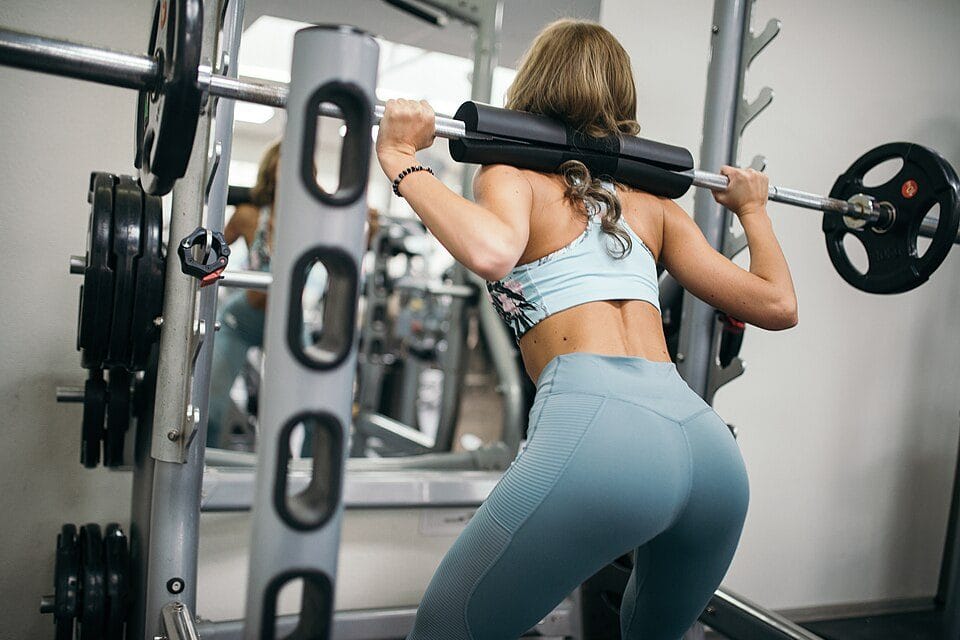
A 30-year-old woman who deadlifts twice a week is doing more for her 70-year-old self than she probably realizes. Bone isn't a fixed structure you're issued at birth and slowly wear down like tire tread — it's living tissue that responds to mechanical stress the same way muscle does, building itself back stronger when you load it and quietly shedding density when you don't. The catch is that most women never get taught this, so the loading happens by accident (if it happens at all) instead of on purpose.
Why Bone Loss Hits Women Harder
Women build roughly 90% of their peak bone mass by age 18-20 and reach the actual peak — the highest bone density they'll ever have — somewhere around 30. From there, the slow decline that affects everyone kicks in, but women get hit with a second, much steeper drop that men simply don't experience: the estrogen crash of perimenopause and menopause. Estrogen suppresses the cells that break down bone (osteoclasts), so when levels fall — typically over the four to eight years surrounding a woman's final period — that brake comes off. Bone loss during this window can run 1-2% per year, and for some women it's faster, meaning a woman can lose 10% or more of her bone density within a decade of menopause onset. Men lose bone too as testosterone gradually declines, but the process is slower and starts later, which is exactly why the fracture statistics skew so heavily toward women in their 60s and 70s. Nobody hands you a warning label for this at 35, which is precisely the problem — by the time a woman notices anything, the steepest part of the decline is often already behind her.
This is why osteoporosis is overwhelmingly a women's disease in practice, even though the underlying bone biology isn't sex-specific. The Bone Health & Osteoporosis Foundation estimates that roughly half of women over 50 will break a bone due to osteoporosis at some point, compared to about one in four men. A hip fracture in your 70s isn't a minor inconvenience, either — it's one of the events most strongly linked to loss of independence in older adults, and a meaningful percentage of people never fully regain their pre-fracture mobility. None of that is inevitable. It's largely a function of how much bone you built before 30 and how much you preserved after.
How Lifting Actually Builds Bone
Bone responds to mechanical loading through a principle sometimes called Wolff's Law: put enough stress on a bone and it remodels itself to handle that stress better next time, laying down new mineral along the lines of force. This is not a metaphor borrowed from muscle training — it's the literal cellular mechanism. Osteoblasts (the bone-building cells) respond to compressive and impact forces by increasing bone formation, and the effect is site-specific. Squat and deadlift heavy, and you build density in your hips and spine — precisely the two locations where osteoporotic fractures do the most damage.
Here's the part that surprises people who've spent years doing "safe" low-impact cardio for their bones: walking and swimming, while good for cardiovascular health, don't provide nearly enough mechanical stimulus to meaningfully build bone density in adults. Swimming in particular is close to bone-neutral because water removes the gravitational loading that bone needs. If your goal is stronger bones and not just a healthier heart, the training has to include resistance that's heavy enough, or impact that's sharp enough, to register as a real mechanical signal.
The Training That Actually Moves the Needle
The clearest evidence here comes from the LIFTMOR trial, run by bone researcher Belinda Beck at Griffith University in Australia, which put postmenopausal women with low bone density through eight months of heavy, twice-weekly barbell training — deadlifts, overhead presses, and back squats loaded at 80-85% of one-rep max, plus jumping chin-ups for impact. The comparison group did a low-intensity home exercise program instead, the kind most doctors would have recommended at the time for anyone with fragile bones. The heavy-lifting group gained bone density at the spine and femoral neck; the low-intensity group didn't, and in fact lost a small amount over the same period. Height also improved slightly in the heavy-lifting group, a proxy for better spinal posture and less vertebral compression. That result mattered because it directly contradicted decades of conventional advice that told women with fragile bones to avoid heavy loading out of fracture fear. No participant in the heavy-lifting arm suffered a fracture or serious injury from the training itself, which is the detail that tends to surprise people most when they hear about the study for the first time.
Choose loaded compound movements over machines and isolation work whenever bone density is the goal — squats, deadlifts, hip thrusts, and overhead presses put mechanical stress through the hip and spine in a way a leg extension machine simply doesn't. Add impact training on top of it: jump rope, box jumps, or even structured stair sprints create ground-reaction forces well above bodyweight, which is exactly the kind of spike bone responds to. A woman in her 40s with healthy bones has no reason to avoid jumping — the fear of impact training is disproportionate to the actual injury risk for someone without an existing fracture or severe osteoporosis diagnosis.
A Life-Stage Approach to Bone Training
20s and 30s: banking peak bone mass
This is the window where the biological math is most forgiving and the payoff is largest — you're not fighting estrogen decline yet, so anything you build now is close to pure profit for the next four decades. Progressive heavy lifting three to four times a week, combined with some form of impact (running, jump training, team sports), builds the densest possible foundation. Women who reach 30 with strong peak bone mass have a meaningful buffer against the menopausal drop that's coming regardless of what they do.
40s and 50s: training through the estrogen decline
Perimenopause is when consistency starts mattering more than intensity spikes. Twice-weekly heavy resistance training — genuinely heavy, in the 70-85% of one-rep-max range, not the light-dumbbell-and-high-reps version many women default to — is the minimum effective dose based on the LIFTMOR protocol and similar studies. This is also the stage where a DXA scan (dual-energy X-ray absorptiometry, the standard bone density test) becomes worth requesting from a doctor, particularly with a family history of osteoporosis or a smaller frame, since low body weight is itself a risk factor.
60s and beyond: maintaining what you have
Bone responds to loading at any age — the LIFTMOR-FX follow-up trial extended similar heavy training to women in their 70s and 80s and still saw favorable results, alongside improved balance and functional strength that directly reduces fall risk. The training needs closer supervision here, and anyone with an existing fracture or a T-score below -2.5 should work with a physical therapist familiar with osteoporosis before loading heavy. But "too old to lift heavy" is rarely true on the bone-health merits alone. It's more often a caution born from unfamiliarity with resistance training than an actual medical contraindication.
What You Eat Matters Almost As Much
Training provides the stimulus, but bone remodeling needs raw material. The Bone Health & Osteoporosis Foundation recommends 1,000 mg of calcium daily for women under 50 and 1,200 mg for women 50 and older — roughly three to four servings of dairy, fortified plant milk, or calcium-set tofu, since food sources absorb better than supplements for most people. Vitamin D matters just as much because it governs calcium absorption in the gut: 600 IU daily under age 70, 800 IU after, though many women in northern climates or with limited sun exposure need considerably more and should get their blood level checked rather than guessing.
Protein is the piece most women training for bone health underestimate. Bone is roughly 50% protein by volume, and adequate intake — generally 1.6-2.2 grams per kilogram of bodyweight for women who train regularly — supports both the collagen matrix bone is built on and the muscle mass that protects joints during heavy lifting. Skimping on protein while trying to build bone through training is working against yourself with one hand while building with the other.
Risk Factors Worth Knowing
This list is shorter than most women expect.
- Family history of osteoporosis or hip fracture, especially in a parent
- Early menopause (before age 45) or surgically induced menopause
- A smaller, thinner frame, which correlates with lower peak bone mass to begin with
- Long-term corticosteroid use is the most common medication-driven risk factor, though some anticonvulsants and certain cancer treatments carry it too — worth a direct conversation with a prescriber rather than an assumption either way
- Extended periods of amenorrhea (missed periods) from under-fueling or overtraining, which drops estrogen and mimics early menopause at the bone level, among other lesser-known triggers
That last one catches a specific group off guard: women who train hard, eat too little to support it, and lose their period as a result. It feels like discipline. To bone tissue, it reads as a hormonal environment nearly identical to menopause, decades early.
A Weekly Framework That Actually Builds Bone
Two heavy full-body strength sessions per week form the backbone of any bone-focused program, built around squats, deadlifts or hip thrusts, and overhead or bench pressing, loaded at 70% of one-rep max or higher and progressed over months, not weeks. Add one session of impact training — box jumps, jump rope intervals, or sprint work — since impact and heavy loading stimulate bone through slightly different mechanical pathways and combining them outperforms either alone. Round it out with general daily movement and, if desired, lower-intensity cardio for heart health, understood as separate from the bone-building work rather than a substitute for it.
- Monday: heavy squat or deadlift focus, 4-5 sets of 4-6 reps at 75-85% 1RM
- Wednesday: jump training or plyometric circuit, 15-20 minutes, plus mobility work
- Friday: heavy press and hip-hinge focus, 4-5 sets of 4-6 reps, second bone-loading session of the week
Three focused sessions beat six scattered ones. The women who see the clearest bone density improvements in the research aren't the ones logging the most gym hours — they're the ones consistently hitting real intensity on a small number of loaded lifts, month after month, without talking themselves into lighter weights out of caution that the evidence doesn't actually support.