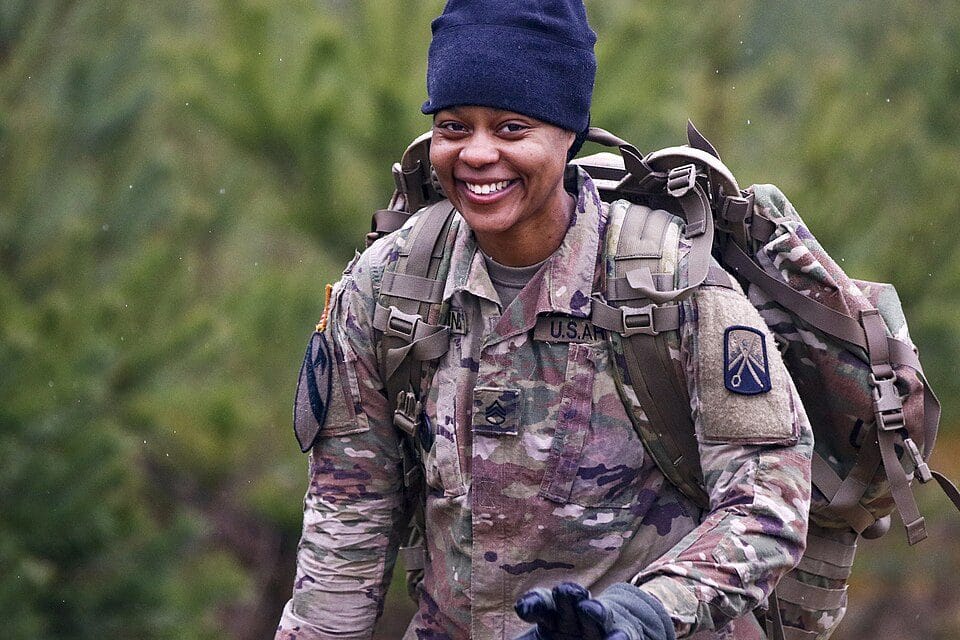
Load a backpack with two 10-pound plates, sling it over your shoulders, and go for the same walk you'd normally take around your neighborhood — the route doesn't change, but almost everything else does. Your heart rate climbs faster than it would carrying nothing. Your glutes, hamstrings, and core switch on to keep your torso upright instead of just swinging your legs forward. And by the time you're back at your front door, you've asked more of your skeleton than a month of unweighted treadmill sessions ever would. That's rucking, and it's one of the more useful additions a woman can make to a training week already built around lifting and steady-state cardio.
What Rucking Actually Is (It's Not Just a Weighted Backpack Walk)
Rucking comes from military ruck marches — soldiers covering distance on foot with a loaded pack, historically as a way to build the specific endurance needed to carry gear over terrain. GORUCK, the company founded by former Green Beret Jason McCarthy in 2008, took that concept and built a civilian fitness culture around it: weighted rucksacks, timed group events, and a training style that sits somewhere between hiking and a strength circuit. You don't need the events or the gear to get the benefit. A daypack, a couple of weight plates wrapped in a towel so they don't dig into your spine, and a route you already walk are enough to start.
What separates rucking from "walking with a bag" is the loading and the posture it demands. A loose pack that shifts with every stride does almost nothing useful and can actually strain your shoulders and lower back. Positioned correctly, a ruck sits high and close to your shoulder blades, with a hip belt taking a share of the weight off your traps — which is why a real rucksack with a padded hip strap is worth the extra cost over a generic school backpack. Get that right, and walking stops being passive. Your core has to resist the pack pulling you forward, your glutes and hamstrings do more work at push-off, and your posture becomes the thing you're actively managing for the whole session.
The Cardio Case: More Effort Per Mile, Less Pounding Than Running
A weighted pack turns an ordinary walk into a workout that can rival a moderate jog in cardiovascular demand — without the joint pounding that sends so many recreational runners to physical therapy. In a 2019 study on rucking commissioned by the American Council on Exercise, researchers found that adding a loaded pack to brisk walking pushed participants into a genuinely vigorous heart-rate zone, well above what the same walking pace produced unloaded. That matters for anyone trying to hit the Centers for Disease Control and Prevention's recommendation of 150 minutes of moderate-to-vigorous aerobic activity a week without adding more running volume to a body that's already managing squat and deadlift sessions.
The impact math is the real advantage here. Walking generates ground reaction forces of roughly one to 1.2 times bodyweight per step; running pushes that closer to two to three times bodyweight. Strapping on 20 or 30 pounds raises the load your joints absorb, but it stays far below what running demands, which is exactly why rucking works so well as a cardio option on days your knees or hips need a break from higher-impact training. You get an elevated heart rate and a real calorie cost, and your cartilage doesn't pay the running tax to get there.
Bone Density: The Benefit Most Cardio Routines Skip
Steady-state cardio — the treadmill incline walk, the stationary bike, the elliptical — does very little for bone. Bone remodels in response to mechanical stress, a principle known as Wolff's Law, and low-impact cardio simply doesn't apply enough load to trigger meaningful adaptation. Weighted rucking does. Carrying external load through a weight-bearing activity is one of the more accessible ways to give your skeleton the kind of stimulus it needs, and that stimulus matters more for women than the fitness industry tends to admit: bone density loss accelerates sharply after menopause, and the exercise habits that build a reserve of bone mass in your 30s and 40s pay off for decades.
This is where rucking earns its place next to strength training rather than as a substitute for it. Barbell work still does more for bone density per session, because the loads involved are higher relative to bodyweight. But rucking adds volume of loaded weight-bearing time that a two- or three-day lifting split can't provide on its own, and it does so on days when you'd otherwise default to a walk that offers your skeleton nothing beyond calorie burn. Treat it as a complement to your squat and deadlift work, not a replacement for either.
How Much Weight to Carry — and How to Carry It Right
Start at 10 percent of your bodyweight. That's the guideline most rucking coaches and GORUCK's own training material converge on for beginners, and it's a sensible one — a 150-pound woman starting around 15 pounds gets enough load to feel the difference without wrecking her form in the first mile. Experienced ruckers gradually build toward 20 to 25 percent of bodyweight over months, and military ruck marches load considerably heavier than that, but there's no reason to chase those numbers early. The goal in your first weeks is clean posture at a sustainable weight, not an impressive number on a plate.
Start lighter than your ego wants.
Gear matters more here than in most strength training, because a bad pack turns a joint-friendly workout into a shoulder-friendly one. A GORUCK GR1 with a dedicated ruck plate runs $200 to $300, which is a real investment — but a $60 daypack from REI or a similar outdoor retailer, loaded with plates wrapped in a folded towel or an old yoga mat, does the job for a fraction of the price as long as it has a padded hip belt and sits high on your back. Skip anything without a sternum strap or hip support; those packs shift weight onto your shoulders alone, and that's how a rucking habit turns into a rotator cuff complaint within a month.
A Beginner Rucking Plan for Your First Six Weeks
Two sessions a week is plenty to start, ideally on days that don't follow a heavy lower-body lifting session. In week one, aim for 20 to 30 minutes at a comfortable pace with 10 percent of your bodyweight loaded, focusing entirely on posture — shoulders back, ribs stacked over hips, no forward lean at the neck. From there, progress the way you would with any loaded exercise: add time before you add weight, and add weight before you add pace. A reasonable six-week arc looks like this, though it's a framework to adjust, not a script to follow exactly.
- Weeks 1–2: 20–30 minutes on flat ground, loaded at 10% of bodyweight.
- Weeks 3–4: stretch to 35–45 minutes and add gentle hills if your route has them, keeping the load the same.
- Weeks 5–6: most women are ready for 45–60 minutes at 12–15% bodyweight, though some do better extending distance first and adding weight later — there's no single right order here.
By week six, most women can comfortably hold a rucking session at 45 minutes to an hour without their form breaking down, which is a solid baseline for folding rucking into a weekly routine long-term. Once a week keeps the bone-loading and cardio benefits ticking over; twice a week is where the improvements in both actually start to show up on a scale a doctor or a DEXA scan would notice.
Mistakes That Turn a Good Workout Into a Bad Week
The most common error is loading too much weight too soon, because rucking feels deceptively manageable in the first ten minutes and punishing by minute forty. Overloading doesn't just make the walk harder — it collapses posture, and a collapsed posture under load is how ruckers end up with lower-back pain that has nothing to do with a weak core and everything to do with a pack that's 10 pounds heavier than their technique could handle. The fix isn't complicated: drop the weight, rebuild the habit, and add load back slowly over weeks rather than sessions.
The second mistake is footwear. Trail running shoes or a supportive walking shoe with real cushioning matter more under load than they do on an unweighted walk, since every pound in the pack adds to what your feet absorb on each step. Skip minimalist or barefoot-style shoes for rucking sessions until you've built real experience with load — they're a poor match for the added ground contact force, however much you like them for regular training. And don't ruck in the same worn-out running shoes you've been meaning to replace for months; that's exactly the kind of shortcut that turns a good habit into a shin splint.