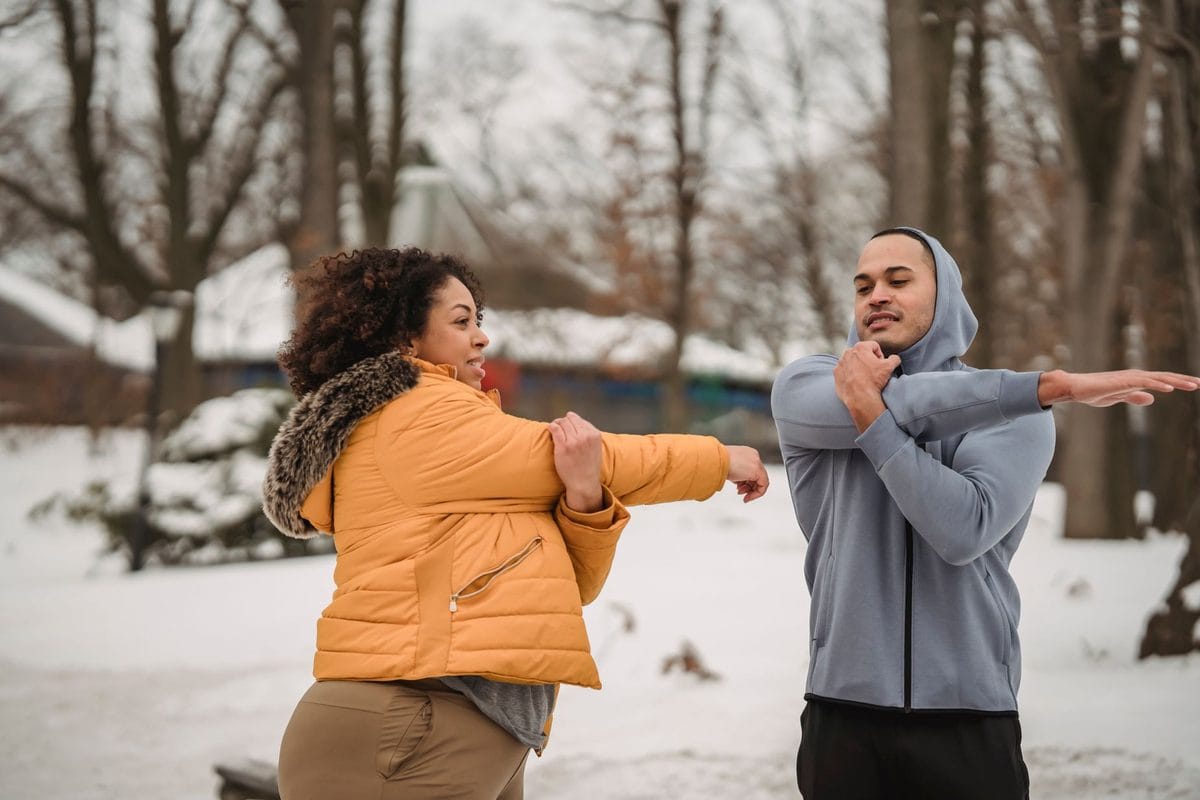
The first properly cold morning of the season usually arrives without warning. You step out toward the car, feel the air bite at your ankles, and by the time you reach the gym your squat feels a little off, as if the bar weighs more than it did last week. Most women put that down to poor sleep or a long day. Sometimes that is the answer. Often, though, your muscles are simply colder than they were in August, and the warm-up you did in summer is no longer enough.
Autumn is when many women change their training without deciding to. The outdoor run turns into a treadmill session, the early workout starts in the dark, and the warm-up quietly shrinks to two minutes of walking. The rest of this article looks at what the research says about warming up, what public health guidance says about exercising in the cold, and how to adjust your session so the season works with you.
Why cold muscles feel slow
Muscle temperature matters because it changes how a muscle behaves. A widely cited review of warm-up research, published in Sports Medicine in 2003, groups the proposed mechanisms into temperature-related and non-temperature-related effects. The temperature-related ones include reduced muscle stiffness, faster nerve conduction, and a shift in the relationship between how hard a muscle pulls and how fast it shortens. In plain terms: a warmer muscle can generate force more quickly, and a stiffer, colder one tends to take longer to get going.
That same review is also refreshingly honest. Its abstract states that despite limited scientific evidence supporting their effectiveness, warm-up routines are a well-accepted practice. So the research does not say that every warm-up is essential for every person in every session. It says the mechanism is plausible and has been studied, but that the size of the benefit depends heavily on how the warm-up is done.
What a recent review says about force and speed
More recent work has been more specific about the performance side. A 2025 review of muscle warm-up studies concluded that increasing muscle temperature, whether through active exercise or passive means, moderately improves dynamic, fast-velocity force production and the rate at which force develops. Those two outcomes matter most for jumping, sprinting, and the first explosive reps of a lift. Heavy slow grinding sets, by comparison, are less sensitive to a short warm-up.
Pay attention to the word "moderately." The benefit is real but not dramatic. If your warm-up is the difference between a lift that feels sluggish and one that feels crisp, that is a useful change. It will not turn a poorly planned session into a personal best. Think of the warm-up as a way to make your first working sets representative of what you can actually do, not as a magic switch.
What guidance says about training in the cold
The American College of Sports Medicine has published public guidance on exercising in cold weather. Its advice centers on three habits: a proper warm-up before you start, layers you can adjust, and steady hydration. The warm-up point is the one most people skip, and it is the one that matters most when you start in a chilly room or outdoors before the sun is up.
Review articles on sport in cold environments make a related point about clothing. A warm-up in heavy, damp clothing can leave you overheated and sweaty before the real work begins, and then you cool down quickly once you stop. The practical answer is a moisture-wicking base layer, a light insulating layer you can remove as you warm up, and a windproof outer layer you keep for the walk home. The goal is to be comfortable at the start and not soaked by the end.
Hydration deserves a mention too. In cold weather you may not feel thirsty during a session even though you are still losing fluid through breathing and sweat. A drink bottle on the bench is a simple reminder, and it costs nothing.
How to change your warm-up for the cold months
You do not need an hour-long routine. You need a sequence that raises your temperature, moves your joints through the ranges you will use, and builds up to your working weight gradually. Here is a structure that works for most lifting sessions, adapted from general warm-up principles in the sports medicine literature:
- General warm-up (4 to 5 minutes): an easy bike, rower, or brisk walk on an incline, until you feel warm and your breathing has picked up. You should be able to speak in full sentences.
- Joint preparation (2 to 3 minutes): leg swings, hip openers, thoracic rotations, and a few slow bodyweight squats. Keep the movements controlled rather than bouncy.
- Ramp-up sets (4 to 6 minutes): two or three light sets of your first lift, with the weight climbing each time. Stop each set with a few reps still in reserve, so the warm-up does not become a workout of its own.
- First working set: start the session at the weight you planned, and only then decide whether you feel strong enough to add load.
If you train before work in the dark, start with lower-demand exercises such as goblet squats, glute bridges, or push-ups before you touch heavy barbell work. Your body will tell you quickly whether it is ready. A joint that feels stiff in the first five minutes usually loosens with the right warm-up, but a sharp or unfamiliar pain is a reason to stop and reassess rather than push through.
Where the evidence is thinner than you might expect
It is worth being clear about the limits here. Most of the warm-up research looks at short-term effects in controlled settings, usually with sprint, jump, or power tests. Very few studies follow women through a full autumn training block to see whether a longer warm-up changes injury rates or long-term strength. The mechanisms are well understood, but the exact protocol that suits you is something you will need to find by paying attention.
There is also a counterpoint worth taking seriously. Some women train well in a cold gym and feel nothing unusual at all. If your session is mostly moderate-load work and your warm-up is already thorough, a cold room may change very little. The practical test is simple: notice whether your first working sets feel slow, stiff, or unusually heavy compared with the same weights in warmer months. If they do, lengthen the warm-up. If they do not, you have more flexibility than you thought.
A simple plan for the next four weeks
Pick one change and keep it for a month, rather than rebuilding your whole routine at once. Three options work well for most people:
- Add the four-minute general warm-up to every session, even the ones that feel short on time.
- Change your layers so you start with one fewer item than you think you need, then add a layer only if you are cold during the warm-up.
- Keep a short note after each session: how your first working set felt, and whether the warm-up was long enough. After three or four weeks, the pattern will be clearer than any general rule.
The cold months are a good time to be more deliberate about warming up. The sessions are often shorter, the mornings are harder to start, and it is easy to rush the part you think you can skip. Give the first ten minutes the same attention as the heaviest set, and your training is likely to feel more like the version of you that trains in the summer.