Ask a woman in her mid-forties what she's doing to protect her knees, and she'll usually have an answer — foam rolling, mobility work, maybe a physio she sees twice a year. Ask what she's doing to protect her bones, and the answer is often silence, followed by "isn't that a menopause thing, later?" It isn't later. By the time a DXA scan flags osteopenia, a woman has typically already lost bone density she can't fully recover, and the training decisions that would have mattered most were made — or skipped — a decade earlier, usually because heavy lifting felt unnecessary, or because someone once told her it was dangerous.
That advice was backwards, and the clearest evidence for why comes from a trial that deliberately set out to break the old rule.
Why the bone-loss clock starts ticking before anyone calls it menopause
Estrogen does more in the body than regulate the menstrual cycle — it also restrains osteoclasts, the cells that break down old bone faster than osteoblasts can rebuild it. When estrogen production falls during perimenopause, that restraint loosens, and bone turnover tips toward loss well before a woman's final period arrives. The Bone Health & Osteoporosis Foundation puts a number on how steep that drop can be: up to 20% of a woman's bone density can disappear in the five to seven years surrounding menopause, with the spine and hip absorbing most of the damage. Some women lose bone gradually across that window, in line with the roughly 10% average reduction researchers have documented across the full menopausal transition. Other women lose it fast, in the range of 3 to 5% a year during the roughest stretch, according to figures reported by Mass General Brigham's menopause program. Left unaddressed for a decade, that pace can move someone from healthy bone density into osteoporosis territory without a single broken bone ever serving as a warning.
None of this shows up as pain. Osteopenia and early osteoporosis are functionally invisible until a fracture happens — a wrist break from a minor fall, a hairline crack in a vertebra that shows up incidentally on an unrelated scan — which is exactly why the exercise conversation needs to start well before the diagnosis does.
The trial that broke the "lift light, stay safe" rule
It shouldn't have worked, according to the conventional wisdom of the early 2010s.
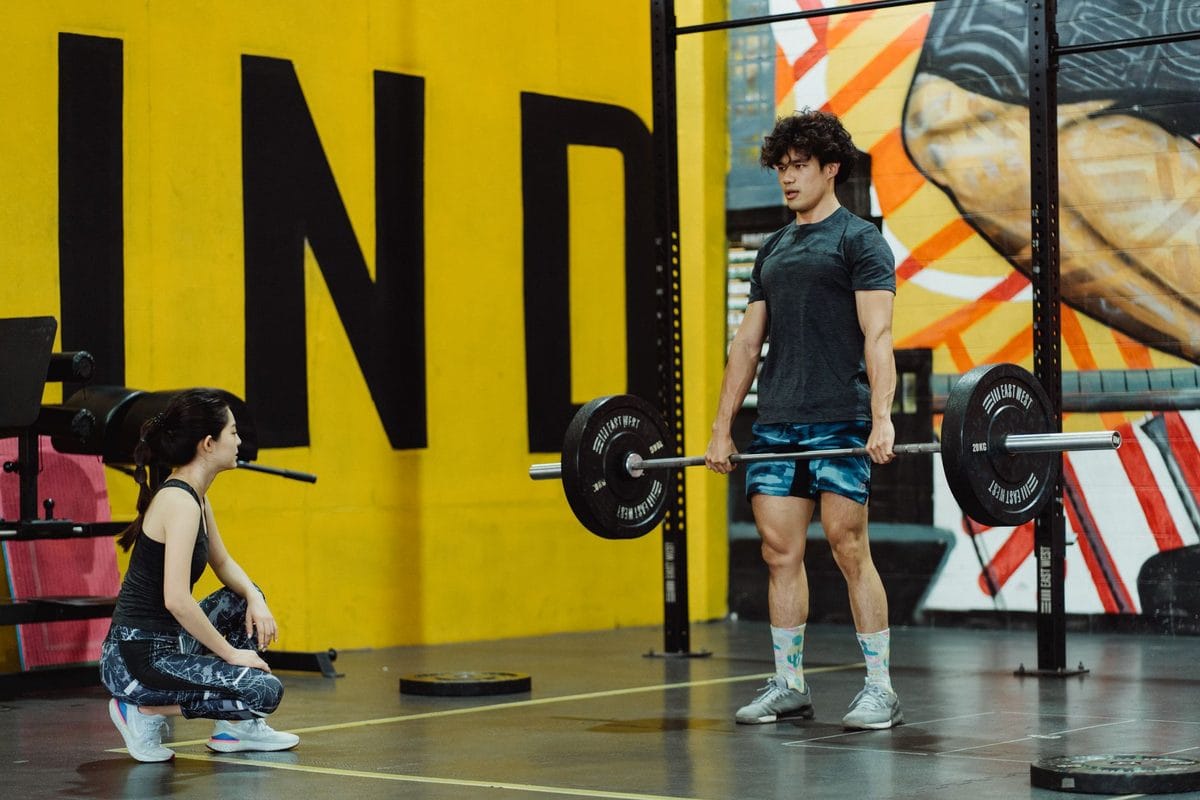
For decades, women with low bone mass were told to avoid high-impact and heavy-load exercise altogether, on the assumption that loading fragile bone was more likely to cause a fracture than prevent one. A team at Griffith University in Queensland, led by bone researcher Belinda Beck, tested that assumption directly with the LIFTMOR trial, published in the Journal of Bone and Mineral Research. Researchers randomized 101 postmenopausal women with low bone mass — T-scores below −1.0, average age 65 — into either eight months of twice-weekly, 30-minute supervised high-intensity resistance and impact training, or a low-intensity home program used as the control. The training group didn't ease into light machine work: their program centered on five sets of five reps at more than 85% of one-rep max on deadlifts, overhead presses, and back squats, paired with jumping chin-ups for impact loading.
The results reversed the caution that had shaped exercise prescription for this population for a generation. Lumbar spine bone density rose by an average of 2.9% in the training group while the control group's dropped by 1.2%. Femoral neck density held essentially flat at +0.3% in the training group against a 1.9% decline in the control group, and femoral neck cortical thickness — the outer shell of bone that matters most for hip fracture resistance — improved more than twice as much in the lifting group. Adherence was high, at 92%, and across the entire eight-month trial there was exactly one adverse event: a minor lower back spasm that cost two missed sessions out of seventy. No vertebral fractures. No stress fractures. No confirmation of the injury risk the field had spent decades assuming was there.
What "progressive overload" means when the target is bone, not muscle
Muscle responds to a wide range of training loads — you can build size and strength anywhere from 30% to 90% of your one-rep max if you push sets close to failure. Bone is pickier. It follows a version of Wolff's Law: it remodels in response to mechanical strain, but only strain that clearly exceeds what the skeleton already handles day to day. Walking, light dumbbell circuits, and most group fitness classes don't come close to that threshold for someone who's already reasonably active, which is part of why so many moderately active women still see bone density decline on their DXA scans. The LIFTMOR protocol's above-85%-1RM threshold wasn't arbitrary — it reflects a body of exercise-science literature, including the ACSM's position stand on exercise and bone health, indicating that osteogenic loading needs both high magnitude and a rapid rate of loading, which is why the program paired heavy lifts with jump-based impact work rather than relying on slow strength training alone.
A 2021 meta-analysis by the same Griffith University group, published in the journal Bone, pooled results across multiple postmenopausal exercise trials and found a similar pattern: higher-intensity resistance and impact protocols consistently outperformed low- to moderate-intensity programs for lumbar spine and femoral neck outcomes, while the lower-intensity programs frequently failed to distinguish themselves from no exercise at all. That's an uncomfortable finding for anyone who's been doing a gentle strength class twice a week and assuming it's protecting their skeleton — it very likely is protecting muscle mass, balance, and cardiovascular health, none of which are nothing, but the evidence doesn't support counting on it for bone density specifically.
Get a baseline DXA scan in your late thirties or early forties, not after your first fracture — bone density trends matter far more than any single number, and there's no way to track a trend you never started measuring. Free weights loaded near your actual working max are what produced the results in these trials, not machine circuits at a chain gym set to a moderate weight that still lets you chat between sets; if a set of five reps doesn't feel genuinely hard by the last rep, it's very likely under the threshold bone needs to respond to.
Where walking and swimming fall short — and where they still matter
This is the part that surprises people who've built a fitness routine around low-impact cardio for years. Weight-bearing doesn't mean what it sounds like in casual conversation: swimming and cycling, despite involving plenty of exertion, apply almost no direct mechanical strain to bone, and multiple comparative studies have found competitive cyclists and swimmers carrying measurably lower bone density than runners or lifters of similar fitness levels. Walking is weight-bearing in the technical sense, but the ground-reaction forces it generates are too low and too repetitive to register as a meaningfully new stimulus to a skeleton that already walks several thousand steps most days.
None of that makes cardio pointless — cardiovascular fitness, balance, and fall-prevention all matter enormously for someone's actual fracture risk, and a woman who never puts a barbell on her back but walks daily and practices balance work is still meaningfully better off than one who does neither. The honest caveat is narrower than "cardio doesn't help bone": it's that cardio alone, without any loading that approaches or exceeds habitual strain, is unlikely to move a DXA number in either direction on its own.
Protein, calcium, and vitamin D support the adaptation — they don't replace it
Bone remodeling after a heavy training session doesn't happen in a nutritional vacuum. Adequate protein intake, generally cited in sports-nutrition research at around 1.2 to 1.6 grams per kilogram of body weight daily for adults doing resistance training, supplies the amino acids needed to build the collagen matrix that mineral gets laid down on — skimping on protein while lifting heavy is a bit like buying lumber for a house frame and then not ordering enough nails. Calcium and vitamin D matter too, though their role is more about ensuring mineral is available to deposit than about driving the remodeling signal itself; the Bone Health & Osteoporosis Foundation recommends 1,000 to 1,200 milligrams of calcium daily for most adult women, rising toward the upper end after menopause, alongside vitamin D intake sufficient to keep blood levels in a normal range, which for many people in northern latitudes means supplementation rather than sunlight alone.
None of that nutrition checklist substitutes for the mechanical stimulus. Plenty of women hit their calcium and vitamin D targets according to a supplement bottle's label and still show declining bone density on their next scan, because supplementation addresses raw material availability, not the biological signal that tells the skeleton to use it. The LIFTMOR trial didn't standardize participants' diets beyond screening out conditions that affect bone, and it still produced a 2.9% gain in lumbar spine density — the loading did the work.
Starting safely if you already have osteopenia or osteoporosis
The LIFTMOR results don't mean walking into a gym and loading a barbell to 85% of an untested max is a reasonable first session — the trial's safety record came from close supervision, individualized load prescription, and a slow ramp from lighter loads up to that top-end intensity over the first several weeks. Anyone with an existing osteoporosis diagnosis, a prior fragility fracture, or significant spinal compression should work with a physical therapist or a trainer who has specifically studied bone-loading protocols, not a generic strength coach, because form errors under heavy spinal loading carry different stakes for someone with reduced bone density than for someone without it.
A follow-up program from the same Griffith University research group, MEDEX-OP, went on to test whether combining this kind of training with bone medication produced better outcomes than either approach alone for postmenopausal women with low bone mass — a reminder that resistance training is a powerful lever, not a replacement for a bone-health conversation with a physician once the diagnosis already exists.
Most gyms still hand new members a laminated card with the leg-press and lat-pulldown machines circled as the safe starting point. The exercises that actually changed bone density in a randomized trial were a barbell deadlift, an overhead press, a back squat, and a jump.