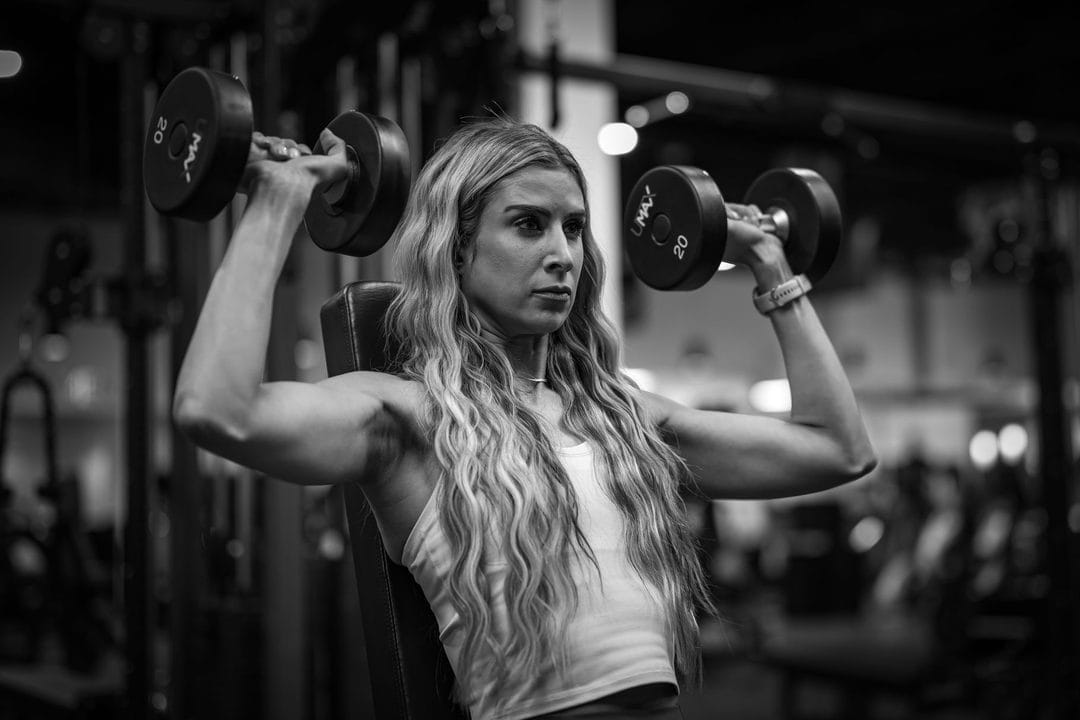
Most women who start lifting heavier notice the same thing around month three. Squats get stronger, deadlifts climb, and then the overhead press stalls at a weight that feels absurdly light for everything else. The shoulder is usually the reason. It is a joint built for range of motion more than for load, and it depends on a small group of rotator cuff muscles to keep the ball of the upper arm bone centred in the socket while the big muscles around it do the heavy work. When those small muscles are underprepared, the lift stops rather than fails cleanly, and the pain shows up as a nagging ache at the front or top of the shoulder.
This is also why the advice to just push through it fails so often. A tendon that is loaded above its current capacity rarely snaps in one dramatic moment. It gets irritated, then it gets angry, and eventually the shoulder spends a week refusing to lift a coffee mug. Tendinopathy, the umbrella term clinicians use for this kind of overload injury, tends to build over weeks of ignoring small warnings. Overhead athletes in swimming, volleyball and CrossFit see it constantly, and recreational lifters are not immune. Load is the variable you control, and it is the one most lifters adjust last. A simple rule helps: if an exercise that used to feel easy now produces a sharp pinch at the same point in the range every session, you have a mismatch between load and capacity, not a character flaw.
The Rotator Cuff Muscles Worth Training
Four muscles make up the rotator cuff: supraspinatus, infraspinatus, teres minor and subscapularis. For practical purposes, most of the targeted work goes to the external rotators, infraspinatus and teres minor, and to subscapularis, which handles internal rotation and helps stabilise the joint at the bottom of a press. The supraspinatus gets worked indirectly through the lifts you already do, especially with slow, controlled raises in the plane of the shoulder blade. Most women benefit from doing external rotation twice a week because that is where the tendons tend to be least conditioned. The muscles respond to moderate load and higher repetitions better than to maximal effort, which is why this work looks almost embarrassingly light on the bar. Expect to use a resistance band or a 2 to 5 kilogram dumbbell for most of it. Progress by adding repetitions or slowing the lowering phase rather than chasing a heavier number.
External rotation with a band
Anchor a light resistance band at elbow height, stand side-on to the anchor, and hold the band in the hand farther from it. Bend the elbow to about ninety degrees and tuck it against your ribs. Rotate the forearm outward, keeping the elbow pinned, until the back of the hand points away from your body. Pause for a second, then return slowly over about three seconds. Three sets of twelve to fifteen per side is a sensible starting point. Stop the set when your form slips and the elbow drifts away from the ribs, since that drift means the shoulder is doing the work instead of the cuff. A band from Theraband in a light resistance colour, usually yellow or red, is enough for most beginners. Do this before your press, not after, so the cuff is awake when the load arrives.
Scapular control: Y-T-W and face pulls
The shoulder blade is the platform the arm lifts from, and it has to move on cue. Lie face down on a bench with light dumbbells, or stand and perform the movement with a band, then raise your arms into a Y, a T and a W shape, pausing at each position. The Y works the lower trapezius, the T the middle traps and rhomboids, and the W the external rotators working together with the serratus anterior. Face pulls to the forehead with a rope attachment cover much of the same ground under load. Many women skip the scapula entirely and then wonder why the overhead press feels like it pinches the front of the shoulder. Honestly, I think face pulls are the single most useful exercise here, because they fix posture without a separate lesson. Keep the elbows high and pull the rope apart at the end of the movement.
How to Program It Without Wrecking Your Pressing Day
Shoulder prehab should not become a second workout that eats your recovery. Place the cuff and scapular work at the start of a session, after a short warm-up of arm circles and band pull-aparts, and keep the total volume to about ten to fifteen minutes. Two sessions a week is enough for most intermediate lifters, and three is the upper limit before fatigue starts to leak into your main lifts. If you press heavy on Monday, schedule the heavier cuff work on a day you are not pressing. The overhead press itself does not need to be dropped. It needs a sensible progression, and a deload week every six to eight weeks gives the tendon time to catch up with the bar. Track the work in the same notebook as your main lifts so you can see the trend instead of guessing from memory.
- Band external rotation: 3 sets of 12 to 15 per side, slow lowering.
- Face pulls: 3 sets of 12 to 15, elbows high, rope to forehead.
- Y-T-W raises: 2 sets of 8 per letter, light dumbbells or none at all.
- Side-lying external rotation: 2 sets of 10 per side with a 1 to 2 kilogram dumbbell.
- Other options exist, among them cable external rotation and serratus punches.
- Swap in a landmine press when the strict barbell press starts to pinch, and keep the rest of the week's plan intact.
Mistakes That Keep the Shoulder Irritated
The first mistake is treating cuff work as a warm-up you can rush. Most women do the band exercises quickly, grab the barbell, and then wonder why the press still hurts. Slow tempo matters more than most people expect, so count three seconds on the way down and pause for a moment at the stretched end. The second mistake is chasing the bar instead of the position. A press that starts with the elbows flared forward and the ribs flaring up forces the front of the shoulder to absorb the load, and that is exactly the tissue you are trying to protect. Stack the ribs over the pelvis, keep a tight midline, and let the bar travel in a gentle arc around the face. The third mistake is training the same plane every day. If every session is pressing and every accessory is a front raise, the back of the shoulder never gets a say. Balance pulling with pressing, with roughly one pulling set for every pressing set in a general programme, and the joint gets a more even load. Little of this is glamorous, which is probably why it gets skipped.
Women who come back from a shoulder setback often make one more mistake: they return to full load too quickly because the pain has gone. Pain relief is a poor signal of tendon readiness, because the tendon can still be underloaded even when the ache is quiet. A better sign is that you can complete the full working set of the cuff exercise without the pain changing, and that the same holds the next morning. Build back in small steps of about five to ten percent in load, or one or two repetitions per week. Keep a short log next to your sets, with a simple score out of ten at the end of each session, and watch the trend over two weeks rather than reacting to a single bad day. This is not dramatic, and it works better than heroic comebacks. Mild discomfort during a set is not automatically dangerous, since many lifters train with a little ache for years, but a rising score is the thing to act on.
When Shoulder Pain Means Stop, Not Push Through
Some shoulder pain is information, and some is a warning to stop.
Discomfort that appears during warm-up cuff work and fades by the working sets is usually manageable with a lighter load and better tempo. Pain that sharpens during a movement, wakes you at night, or lasts more than a day after training is different, and it deserves a proper assessment rather than another round of band work. Night pain in particular is worth noting, because it often means the tendon is irritated at rest, not only under load. Numbness or tingling down the arm, new weakness, or a shoulder that suddenly clicks and locks are reasons to see a physiotherapist or sports medicine doctor soon. A good physiotherapist will test the cuff, the neck and the upper back, since symptoms often come from more than one place. Many people wait months because the shoulder still moves, but movement is not the same as health. Get it looked at early, and the fix is often a few weeks of structured loading rather than surgery.
Put the band in your gym bag next to the lifting shoes. Do the first set before you even warm up the bar.